Climate-smart agriculture in Zambia
The Assumption About the Neighbours
Every estimator here assumes your neighbour's decisions do not reach you. In a farming village that is plainly untrue.
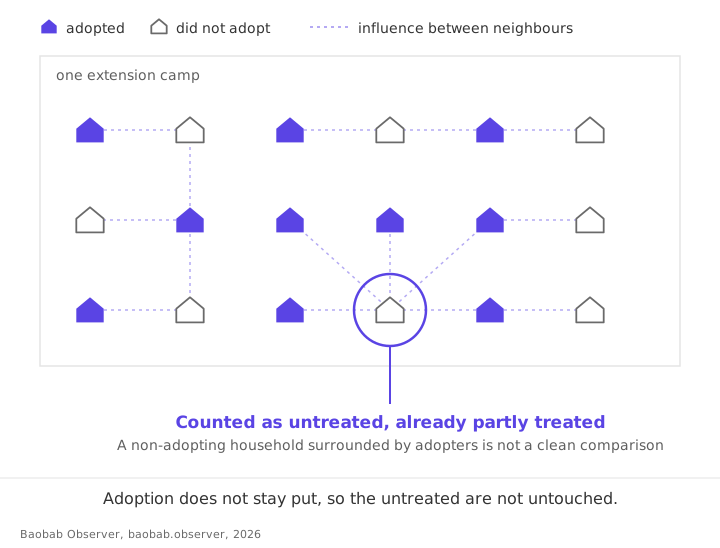
Underneath every estimator in this section sits an assumption so ordinary it usually goes unstated: that a household’s outcome depends on what that household did, and not on what its neighbours did.
It has a name, the Stable Unit Treatment Value Assumption, and in Zambian farming it is plainly untrue.
Extension is delivered through agricultural camps. Farmers watch each other, borrow equipment, and take up a practice because the man on the next plot tried it and his maize stood up through a dry spell. Demonstration is not a leak in the system, it is the mechanism the whole extension model is built to exploit.
If neighbours affect each other, the comparison breaks in a specific way. A non-adopting household surrounded by adopters is not a clean picture of what happens without the practice, because some of the benefit has already reached it. The gap between adopters and non-adopters then understates what adoption does.
Testing it rather than asserting it
The assumption cannot be proved, but it can be probed. For each household you bring in how much of its camp had adopted, re-run the estimate, and watch whether the number moves.
The discipline is in setting the threshold before you look. Decide in advance how much movement would count as material, then abide by the answer. Set the threshold afterwards and you are choosing a rule that gives you the result you wanted.
What it cannot do
A camp is a convenient boundary, not a real one. Influence does not stop at an administrative line, and a household near the edge of one camp may be learning from someone in the next. The test uses the boundary the data provides, which is not necessarily the boundary that matters.
It also cannot tell you what travelled. Information, seed, a borrowed ripper and a shared opinion about whether the practice is worth the labour all move between neighbours, and this test sees only that something did.
The equation
assumed: Yi = Yi(Di) tested with: Yi = Yi(Di, D̄c)
- Yi(Di)
- household i’s outcome as a function of its own adoption, and nothing else. This is SUTVA
- D̄c
- how much of camp c adopted: the neighbours, brought into the model as a variable
- the test
- estimate both, and compare. If the effect barely moves, the assumption is doing little harm
The first line is what almost every causal method assumes without saying so. The second line is the same thing with the assumption relaxed, which is the only way to find out what it was costing.
From the Zambia climate-smart agriculture research, built on the Water and Soil Accelerator household survey, which was funded by USAID. The thesis is under examination and the three papers drawn from it are under anonymous peer review, so there is nothing to link to yet.