Climate-smart agriculture in Zambia
The Causal Forest
An average answers a funding question. It tells an extension officer with one motorbike nothing at all.
Averages are the right answer to a funding question and the wrong answer to a targeting one. Knowing that a practice pays on average tells a ministry whether to run the programme. It tells an extension officer with a motorbike and a fuel allowance nothing about which villages to ride to.
A causal forest estimates the effect household by household. It grows a large number of decision trees, each splitting households into groups by their characteristics, and estimates a separate effect inside each group.
The safeguard, which is called honesty
Grown carelessly, that machinery will manufacture variation that is not there, because a tree can always keep splitting until every group looks special.
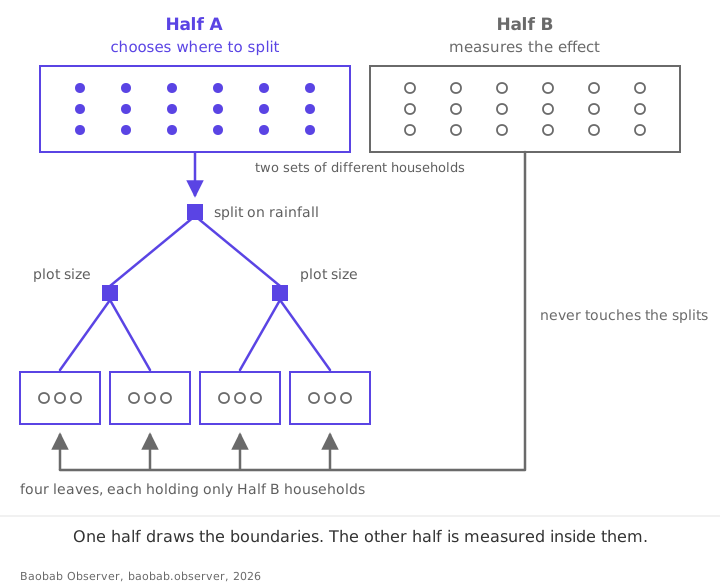
The guard against it goes by the name honesty. One part of the sample is used to decide where to split. A different part is used to measure the effect inside the resulting groups. The tree does not get to choose the groups and then mark them on the same households.
What it cannot do
It finds variation along the characteristics you measured. If the thing that really determines who benefits was never in the survey, the forest will confidently sort households by something else.
The equation
τ(x) = E[ Y(1) − Y(0) | X = x ]
- Y(1)
- what this household gets if it adopts
- Y(0)
- what the same household gets if it does not
- X = x
- for households with these particular characteristics
- τ(x)
- the effect for that kind of household, rather than for the population
Both Y(1) and Y(0) appear for the same household, and only one of them is ever observed. That impossibility is the reason every method on this page exists.
Further reading
- Wager, S. and Athey, S. (2018). "Estimation and Inference of Heterogeneous Treatment Effects using Random Forests", Journal of the American Statistical Association. Read it.Where the method is introduced.
- Athey, S., Tibshirani, J. and Wager, S. (2019). "Generalized Random Forests", Annals of Statistics. free Read it.Where honesty is set out properly, and why it is not optional.
From the Zambia climate-smart agriculture research, built on the Water and Soil Accelerator household survey, which was funded by USAID. The thesis is under examination and the three papers drawn from it are under anonymous peer review, so there is nothing to link to yet.