Maize trade in Southern Africa
The Tobit Model
Most countries trade no maize with each other in most years. A zero is a decision, not a small number.
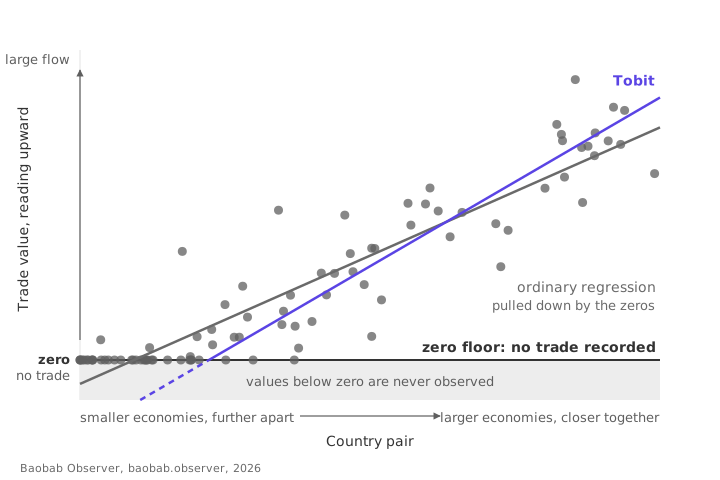
Here is a problem specific to commodity trade. In any given year, most pairs of SADC countries trade no maize at all. The data is full of zeros.
Ordinary regression treats a zero as a very small quantity, which misreads what it means. A zero is not a small trade. It is a decision not to trade, and often the sensible decision. Treating it as a number near zero drags every estimate towards the wrong answer.
A Tobit model, sometimes called a censored regression, handles this by treating the zeros as observations where the real value is hidden below a threshold. It models the decision and the amount together.
The published guidance says this works when you have more than five years, more than ten countries, and at least 40 per cent zeros in what you are explaining. The maize data met all three, which is why the sample was built the way it was rather than trimmed to look tidier.
What it cannot do
It assumes a particular shape for the hidden process that produces the zeros. If a country exports nothing because of a standards dispute rather than because trade was uneconomic, the model cannot tell the difference and will read both as the same decision.
The equation
y*ijt = xijtβ + εijt and yijt = y*ijt if y*ijt > 0, otherwise 0
- y*
- the latent value: how much trade there would be if trade could go negative
- y
- what you actually observe, which stops at zero
- the censoring
- every pair that did not trade is recorded at the same value, 0, whatever their underlying position
Ordinary regression fits a line through those zeros as though they were small quantities. This fits the line to y* and treats each zero as evidence that y* fell below the threshold, which is what a decision not to trade actually is.
Further reading
- Tobin, J. (1958). "Estimation of Relationships for Limited Dependent Variables", Econometrica. Read it.The original, and the reason the model carries his name.
- Santos Silva, J. and Tenreyro, S. (2006). "The Log of Gravity", Review of Economics and Statistics. Read it.The case against what I did. It argues the log-linear gravity model handles zeros badly and proposes a different estimator entirely. Worth reading precisely for that.
From An analysis of maize trade in the Southern African Development Community, MSc (Agricultural Economics), University of Pretoria, 2012. Read it in UPSpace.