Climate-smart agriculture in Zambia
The Five Capitals
Why these variables and not others. A framework that answers the question rather than leaving it to taste.
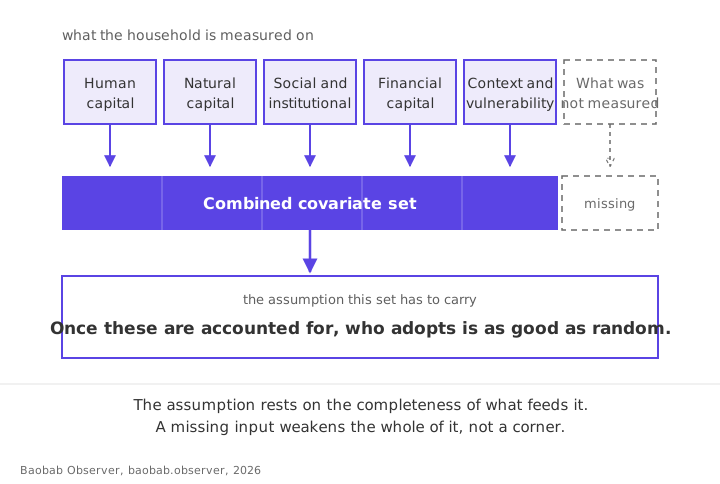
Every model in this section adjusts for the household’s circumstances. Which raises a question that is easy to skate over: why those circumstances and not others?
Answered badly, the covariate list is whatever was in the survey, or whatever made the result look best. Answered well, it comes from a framework that says in advance what shapes a household’s capacity to act.
That framework here is the Sustainable Livelihoods approach, which has been standard in this literature for three decades. It sorts what a household has into five kinds of capital, and the survey measures each:
Human: who is in the household, the age and schooling of whoever heads it, how many adults there are to work. Natural: land, its quality, and the agro-ecological conditions of the province. Social and institutional: membership of a farmer group, contact with extension, and separately whether training was actually received, because contact and delivery are different points on the same pathway. Financial: access to credit for farming, income from off the farm, and connectivity. Context and vulnerability: whether the household has been hit by a shock.
What it cannot do
A framework tells you what kinds of thing matter. It cannot tell you that you measured them well, and it cannot conjure a variable the survey never collected.
The clearest example is in this data. There is no measure of how far a household sits from the nearest extension camp, so the most obvious physical access story in the subject is untestable here. The framework says access matters, the survey did not capture that part of it, and no amount of care with the remaining variables closes that gap.
The equation
X = { human, natural, social, financial, context }
- X
- the covariate set every model in this section conditions on
- the braces
- not a formula so much as a commitment: each domain contributes measured variables, chosen before the results were seen
- what it buys
- a principled answer to "why these controls", instead of a list assembled to taste
The reason this matters is the assumption underneath double machine learning: that once you account for X, adoption is as good as random. That assumption is only as good as the contents of the braces.
Further reading
- Scoones, I. "Sustainable Rural Livelihoods: A Framework for Analysis", IDS Working Paper 72.The framework as it is actually used in rural research.
From the Zambia climate-smart agriculture research, built on the Water and Soil Accelerator household survey, which was funded by USAID. The thesis is under examination and the three papers drawn from it are under anonymous peer review, so there is nothing to link to yet.