Trade & Markets
What AGOA Is Actually Worth
The argument is all about how long AGOA lasts. I wanted to know what it is actually worth, so I worked it out line by line. The median margin comes to 4.4%, and on 37.3% of lines it is worth nothing at all.
The finding, in sixty seconds
- I pulled every line of the United States tariff schedule and matched it to 2025 trade for fifty-four African economies. On 37.3% of lines AGOA is worth nothing, because those products are already duty-free for everybody.
- Where it does apply, the median preference margin is 4.4%, and 59% of lines sit at 5% or less. That is inside a normal quarterly currency swing.
- Apparel is the exception and effectively the whole programme. Median rate 11.3%, peak 32%. It is the one sector where the margin was fat enough to move production.
- The value is wildly uneven. Lesotho’s avoided duty is 18.6% of everything it sells America. Nigeria gets about one cent in every dollar it ships. One negotiating position covers both.
- For the larger economies AGOA has already been cancelled by other American tariffs. Nigeria: $50m of benefit against a $645m Section 301 bill.
- And the part nobody uses: AGOA’s margin on processed food is 101 times its margin on the raw crop, and we ship three times more of the raw. The obstacle there is food safety compliance and cold chain, not tariffs, which is why a longer AGOA does not fix it.
Nineteen minutes if you read the whole thing. The workings, including the places I got it wrong, are all below.
Quick orientation, because this is the first of nine. Over the next couple of months I am going to take the African Growth and Opportunity Act apart and see what is actually inside it. Not what we say about it. What the tariff schedule and the customs data say about it.
Let me start with the thing that has been bothering me.
AGOA lapsed on 30 September 2025. It was restored retroactively, with authority running only to 31 December 2026.
Congress has spent most of this year trying to fix that. The House passed a three-year extension, H.R. 6500, on 12 January 2026, by 340 votes to 54. The Senate then sat on it for seven months. On 8 August 2026 it passed the bill 90 to 6, having first cut the three years down to two and attached the whole thing to the Continuing Appropriations and Extensions Act, which is the stopgap bill Congress passes to keep the lights on when it cannot agree a budget. It has now gone back to the House for a vote on the Senate’s version. As I write, it is not law.
So duty-free access for thirty-two African economies is currently riding on a piece of housekeeping whose main job is to stop the American government running out of money. And somewhere between the two chambers it quietly lost a year.
Now, every contribution to that debate, in Washington and here at home, takes one thing as given. That AGOA is valuable, and the only real question is how long we can keep it.
And I realised, reading yet another piece about the renewal timetable, that I did not actually know how much it was worth. Not roughly. Not in the way you know a thing because you have heard it said. I could not have told you the number.
There is a serious literature on preference margins and on AGOA’s effects, and I am not pretending otherwise. What I wanted was narrower and more stubborn: the margin on every line of the current schedule, matched to what each country actually ships, now, with the 2025 tariff overlay sitting on top of it.
So I went and worked it out.

I should say where I am standing, because it shapes everything that follows. I am an African economist, writing about a statute passed by a legislature I did not elect, which sets the terms on which my continent sells to its second largest market. That is the ordinary condition of African trade policy and it is worth naming out loud. The countries whose futures turn on this Act are not parties to it. They are its subject matter.
And there is a second thing to declare, which is less comfortable. I am not describing somebody else’s mistake here. I am describing one I made twice.
In 2013, at Trade and Industrial Policy Strategies in Pretoria, I led the development of the lobbying paper for AGOA’s extension. That is what it was for. It argued that the programme should be renewed, and it fed into the trade policy stance South Africa went on to take. I do not disown it. But nowhere in it did I stop to ask what the preference was actually worth, line by line, to the exporters it was supposed to serve. That was not the assignment, and it did not occur to me to make it the assignment.
Two years later I wrote a Master’s thesis at the University of Cape Town called An analysis of South Africa exports to the United States under the African Growth Opportunity Act. Its stated purpose was to highlight the importance of AGOA to South Africa and to make the case for South Africa’s continued inclusion in whatever came next. Again I took the value of the thing as given and argued about the terms.
That is precisely the move I have just finished complaining about, and I made it twice: once in a brief written to be used, and once in a bound volume with my name on the front.
So when I say the value of this thing gets assumed rather than checked, understand that I assumed it too, in writing, twice, and that the first time it went to people who were making a decision. What follows is partly me marking my own homework, thirteen years late.
What is a preference actually worth?
Start with the simplest possible question. What is a trade preference worth?
It is worth exactly the tariff it lets you avoid. Nothing more.
Every country the United States trades with normally pays a standard rate, called the most-favoured-nation rate. It is the ordinary price of entry. Because AGOA lets African goods in duty-free, what AGOA is worth on any product is simply the standard rate you would otherwise have paid. If that rate is 16%, AGOA is worth 16% to you. If that rate is zero, AGOA is worth nothing at all, no matter how much trade crosses that line.
That last sentence is where the public conversation goes wrong. And it goes wrong at scale.
So here is what I did. I pulled the live United States tariff schedule, which is the master list of every product and the rate it attracts. I resolved the applicable rate on every line, including the sub-categories that quietly inherit their rate from the heading above them. I identified which lines AGOA actually covers. Then I matched all of it against United States import data for 2025, product by product, for fifty-four African economies.
The schedule alone tells you the first half of the story.
Of 22,795 product lines with a rate I could resolve, 37.3% are already duty-free for everybody. No preference required. On those lines AGOA confers precisely nothing.
And on the lines where AGOA does apply? The median preference margin is 4.4%, and 59% of them sit at 5% or less.
Let us take a moment to reflect on this. A 5% margin is inside the range a currency moves in an ordinary quarter. Nobody sites a factory for it. Whatever AGOA has achieved, it did not achieve it across the broad body of the tariff schedule, because across most of that schedule there was never enough at stake to change anybody’s commercial decision.
There is one conspicuous exception. In apparel, the median standard rate is 11.3%, a third of lines sit above 15%, and the peak is 32%. Apparel is the one place where the margin is fat enough to beat the cost of being far from the market. It is therefore the one sector where AGOA demonstrably moved production. It does not even run through the ordinary tariff lines: AGOA apparel enters under eleven special provisions, including the third-country fabric rule that lets a Kenyan or Basotho factory sew with Asian cloth.
Two Africas, and they want opposite things
Now match those margins to what countries actually ship. This is where it stops being a counting exercise and starts, I think, being an argument.
| US imports 2025 | Of which AGOA reaches | Weighted margin on that | Duty saved | Section 301 bill | |
|---|---|---|---|---|---|
| Nigeria | $5,157m | $4,645m (90%) | 1.1% | $50m | $645m |
| DRC | $1,949m | $1,911m (98%) | 0.9% | $18m | none |
| Angola | $897m | $843m (94%) | 0.5% | $4m | $112m |
| Kenya | $884m | $718m (81%) | 16.1% | $116m | none |
| Madagascar | $716m | $442m (62%) | 19.1% | $84m | none |
| Tanzania | $249m | $135m (54%) | 18.2% | $25m | none |
| Lesotho | $175m | $145m (83%) | 22.4% | $33m | none |
That middle column exists because I made a mistake, and it is worth showing you what it was.
My first version of this table put total exports next to the weighted margin. Put those two numbers side by side and any reader will multiply them together to get the duty saved. Do that and you get the wrong answer in every single row, because the margin applies only to the slice of trade AGOA actually covers, not to everything a country ships. For Tanzania you would have overstated the benefit by roughly 80%.
So I added the slice. And the column I put in to fix a maths problem turned out to carry the argument.
Because look at it. AGOA reaches 54% of what Tanzania sells the United States, and 62% of Madagascar’s. Across all thirty-two eligible economies the median is 42.7%. For South Africa it is 15.7%, which is to say that five sixths of what South Africa sells America has nothing to do with AGOA whatsoever.
That is the number I wish I had put in the thesis. I spent a Master’s arguing for South Africa’s continued inclusion in a programme that touches about one sixth of what South Africa sells the Americans.
Now let me stop myself, because everything above could be read as saying these preferences do not much matter. They matter enormously, and I want to be careful here, because a number like 15.7% is exactly the kind of thing that gets quoted back at a negotiator by somebody looking for a reason to give less.
A share of national trade is not a measure of how much something matters. That is the mistake, and it is not a South African mistake. A national share is diluted across everything a country sells. Dependence is not diluted at all. It sits in particular firms, in particular towns, on particular payrolls.
Take the example I have just been rude about. South African automotive manufacturing employed 115,014 people in 2024, 33,154 of them assembling vehicles and 81,860 in the component sector, and vehicles and components together are 22.6% of the country’s manufacturing output. Citrus is the same story in different provinces, which is why the Citrus Growers’ Association of South Africa turned up and filed in the 2015 eligibility review, alongside the American poultry lobby that had come for it.
The same maths runs everywhere on the continent, and often harder. Senegal takes 74% of its AGOA benefit from prepared fish, and behind that number are processing plants and the boats that supply them. Mauritius takes 31%. Kenya’s is apparel, and so is Madagascar’s, and so is Tanzania’s. Even Nigeria, whose benefit I have just called a rounding error in a national budget, has 95% of it sitting in one sector with its own workforce and its own towns. In every one of those cases the aggregate understates the concentration, because that is what aggregates do.
For those industries the preference is not a percentage of national trade. It is the margin on the order. And when you are quoting against Brazil, Chile, Spain or Australia on a container of oranges, against Vietnam on a garment programme, or against Mexico and Thailand on a build slot, the margin on the order is frequently the difference between getting it and not getting it. A localisation supplier in Gqeberha or a packhouse outside Nakuru does not experience a national share. They experience whether the line runs.
And underneath all of that sits the thing everyone in this debate knows and nobody writes down. No African economy is in a position to be relaxed about market access. Not one of us is choosing between a good option and a better one. Every commercially closed transaction matters, every single one is fought for, and an instrument that helps close some of them is worth defending even when the aggregate looks thin from a spreadsheet.
So the two Africas problem is not that AGOA is unimportant to the larger economies. It is that it is important to them in a completely different way, through a handful of concentrated industries that would feel its loss immediately, than it is to Lesotho, where it is the difference between having an export sector at all and not having one.
Two real interests. Both legitimate. One negotiating position. And notice that the problem gets harder, not easier, once you take both sides seriously.
So the preference is not merely thin where it applies. On most of the continent’s trade it does not apply at all.
Then there are the economies that dominate every headline AGOA figure, the oil exporters, and per dollar shipped they get almost nothing. Crude petroleum enters the United States at a negligible rate anyway. Nigeria’s entire annual AGOA benefit, across $5.2 billion of exports, is about $50 million. That is roughly one cent in every dollar it ships. Angola’s is under $4 million on $897 million, which is less than half a cent in the dollar. In a national budget, those are rounding errors.
They are not rounding errors in the programme, though, and an earlier draft of mine said they were. That was sloppy. Mineral fuels is the third largest source of value in the whole of AGOA, worth $54.6 million a year, or 12% of the total, because a margin under 1% applied to nearly six billion dollars of trade is still real money. Oil is 95% of Nigeria’s AGOA benefit. The point is about who the value is worth something to, not about whether it exists at all.
Now go to the other end of the table. Lesotho’s $33 million of avoided duty is 18.6% of the total value of everything it sells the United States. That is not a trade preference in any ordinary sense of the phrase. That is the margin between having a garment industry and not having one. In 2024, 34,151 jobs sat inside it, down from 49,945 in March 2018 and a peak of 51,325 in 2020.
So the familiar sentence, the one we all use, “AGOA supports billions of dollars of African exports”, is not really wrong. It is closer to meaningless. The accurate version is that AGOA is three programmes wearing one name. Some 60% of its value is a garment scheme for four or five small economies. Another 22% is a thin margin on minerals and fuels, worth little per dollar but adding up because the volumes are enormous. And a small, almost entirely unused fraction is something else again, which I will come to at the end because it is the only cheerful thing I found.
Let me name that third one now, since it is where this whole series ends up. The DRC is the sixth largest beneficiary of AGOA and its benefit is 100% copper. It appears nowhere in the renewal debate. It did not appear in my first draft either.
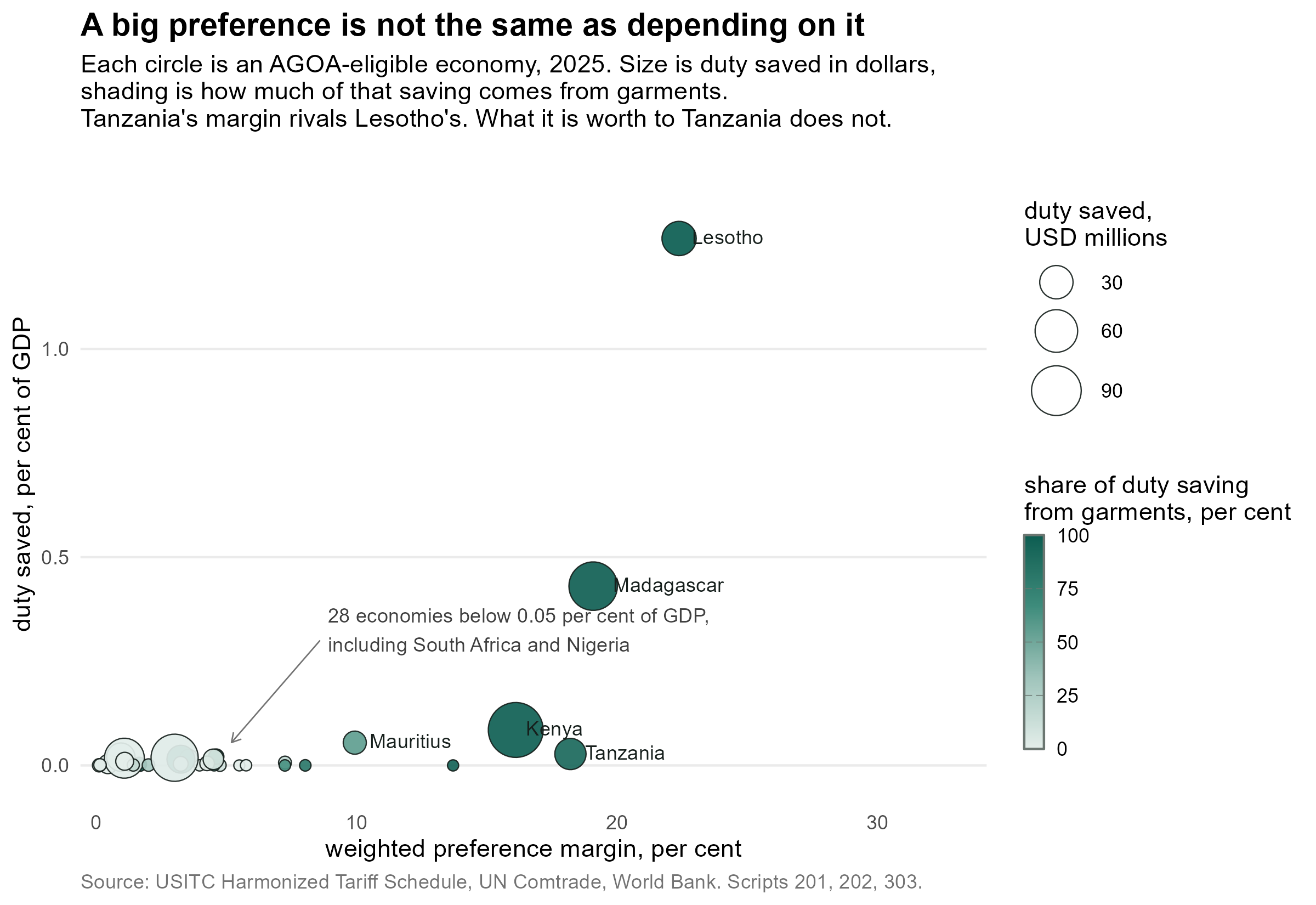
Here is why this matters practically and not just rhetorically. Two groups of countries with almost nothing in common have been represented, for twenty-five years, by a single negotiating position. When our trade ministers travel to Washington together, the large diversified and resource-exporting economies spend political capital on an instrument worth about 1% of their trade, while the countries for whom it is existential get folded into the same undifferentiated ask. Nigeria and Lesotho are asking for the same thing. Only one of them needs it.
There is a serious answer to that and I want to give it properly, because I do not think the bloc position is foolish. Collective advocacy is how small states acquire weight they do not have alone, and Lesotho arguing by itself in Washington would simply be argued past. It also cuts against something deeper. We did not win our independence one country at a time, and the habit of speaking together is not a negotiating tactic we adopted for convenience; it is inherited from the liberation struggle, and there is something genuinely unafrican about telling Maseru to go and make its own case. AGOA also requires beneficiaries to submit national utilisation strategies, so differentiation does exist on paper.
So my objection is narrower than “the bloc is wrong”. It is this: a bloc that cannot say out loud that the instrument is worth sixty times more to one member than another is not bargaining. It is agreeing.
And then it got cancelled anyway
There is a further problem, and for the larger economies it is decisive.
AGOA waives the standard tariff. It does not, and cannot, waive tariffs imposed under a different American law. And those have been arriving in waves.
A quick word on the laws, because the names are alphabet soup and they matter. Section 232 lets the president impose tariffs on national security grounds; it is what sits on metals and vehicles. Section 122 allows a temporary surcharge to deal with a balance of payments problem, and it self-destructs after 150 days. Section 301 lets the president retaliate against practices the United States judges unfair, and the current action is aimed at forced labour in supply chains.
Here is the sequence. The reciprocal tariffs of 2025 sat on top of AGOA. The Supreme Court struck them down on 20 February 2026, and within hours they were replaced by the Section 122 surcharge. That surcharge hit its 150-day ceiling and expired on 24 July 2026, at which point the Section 301 forced-labour action took effect the same morning, putting 10% to 12.5% on some sixty economies. The Section 232 duties sit above all of it.
Now set that against the measurement. The median AGOA preference margin is 4.4%. The Section 301 rate applied to every listed African economy is 12.5%.
For those countries the preference has not been eroded. It has been cancelled on the numbers, several times over. Nigeria’s $50 million of AGOA benefit sits against a $645 million Section 301 bill. That is thirteen dollars taken for every one given.
Section 301 reaches only as far as America’s sixty largest trading partners, and that threshold cuts the continent in two. Above the line, paying the higher rate: South Africa, Nigeria, Angola, Egypt, Morocco and Algeria. Below it, and so paying ordinary rates since 24 July: Kenya, Lesotho, Madagascar, Mauritius, Ghana, Eswatini and Tanzania.
That exemption is six weeks old. It is worth being precise about how recent it is, because the year before it was the exact opposite. The measures that ran through 2025 carried no size threshold at all. They fell on everybody.
The customs data shows it plainly. This is duty actually collected on apparel, as a share of what the shipment was worth:
One caution on the 2025 column before you read it. AGOA itself was lapsed for the last quarter of that year, so part of what looks like the tariff overlay is simply AGOA not existing. Refunds were legislated in February 2026 but they are not automatic, they exclude the reciprocal duties, and the filing deadline has passed. I have not separated the two effects and the figures below should not be read as though the overlay did all the work.
| 2024 | 2025 | |
|---|---|---|
| Lesotho | 0.13% | 8.17% |
| Kenya | 0.07% | 9.64% |
| Madagascar | 0.63% | 10.78% |
| Vietnam | 18.39% | 28.42% |
| Bangladesh | 16.77% | 25.19% |
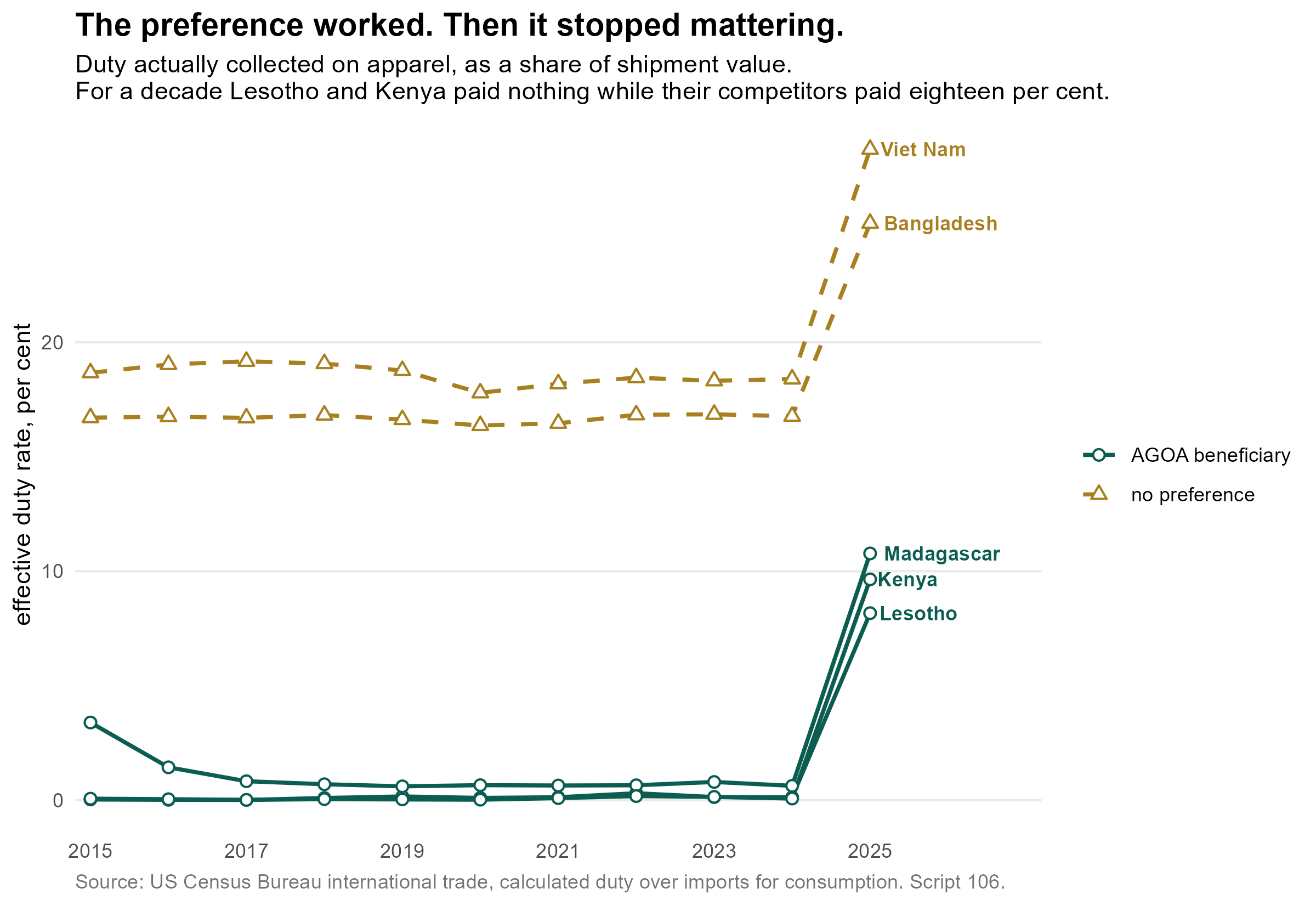
Look at that 2024 column. For a decade Lesotho and Kenya paid essentially nothing while their Vietnamese and Bangladeshi competitors paid 18%. That is the preference working exactly as designed, and it is worth pausing on, because the usual complaint about AGOA is that outside textiles nobody really uses it. In textiles, they used it almost perfectly.
Then in 2025 everybody’s bill jumped eight to ten points at once. The small economies were not spared. They were spared only from what came next.
Which inverts the stakes in a way I genuinely did not expect to find. Since late July, AGOA renewal has been worth a great deal to Lesotho and Madagascar, and much less to South Africa and Nigeria, because for the larger economies a separate law has already taken back more than AGOA ever gave. Where a country sits relative to that threshold now matters more to its access than the preference programme it has spent twenty-five years defending.
I want to resist the neat version of that, which is “it pays to be small”. It does not. Nothing here is a comfortable position to be in. Nigeria’s petroleum sector and South Africa’s citrus growers and vehicle assemblers are organised industries employing a great many people, and the Section 301 bill lands on those payrolls. The countries below the line are not enjoying an advantage. They are experiencing the absence of one particular disadvantage, for now, on terms nobody in Maseru or Nairobi had any hand in setting. On both sides of that threshold these are jobs. The argument for African access to the American market is an argument about work, not about basis points.
It is also a very new state of affairs and nobody should build a strategy on it. The exemption exists because a threshold in one American law happens to fall where it falls. The measures before it had no threshold. The next ones need not have one either.
The part nobody uses
One more measurement, and this is the only cheerful thing in the essay.
The American tariff schedule barely taxes raw commodities and taxes processed food heavily. AGOA removes that escalation completely, and the size of what it removes genuinely surprised me.
| Trade | AGOA margin | |
|---|---|---|
| Cocoa beans | $334m | 0.13% |
| Fruit and nuts | $278m | 0.10% |
| Animal feed | $192m | 0.01% |
| Prepared vegetables and fruit | $120m | 4.60% |
| Prepared meat and fish | $67m | 12.42% |
| Miscellaneous edible preparations | $68m | 14.26% |
Add it up. Africa ships $836 million of raw commodities to the United States at an average AGOA margin of 0.09%, and $258 million of processed food at 9.17%.
The preference on processing is worth a hundred and one times the preference on the raw material. And we ship three times more of the raw.
Senegal already takes 74% of its AGOA benefit from prepared fish. Mauritius takes 31%. Nobody talks about either of them.
And processed food has none of apparel’s pathologies. The inputs are local, so there is no third-country fabric problem and no rules-of-origin trap. There is no second-hand import wrecking the domestic market, because nobody imports used tinned fish. The binding constraint is American food safety registration and cold chain. It is not the tariff.
I should have seen that sooner, because I have already published it. In 2014 I co-authored a paper in Agrekon on strategic markets for South African citrus, with Tinashe Kapuya and Mmatlou Kalaba. One of the things we found was that what made the United States expensive to reach was not the duty. It was the phytosanitary requirement: an extra two days piled on top of the twenty-two days of mandatory cold treatment for false codling moth, plus the shipping distance. A non-tariff cost, on an agricultural product, under AGOA.
That is this finding, twelve years early, in a journal, with my name on it. I did not connect the two until I ran these numbers. They are the same finding.
Which is the whole difficulty with how we are currently arguing. The thing being negotiated for is a longer preference. The preference on the products that would matter most is already sitting there, at 14%, unused.
So what follows
None of this is an argument against renewal, and I want to be unambiguous about that. For the apparel economies renewal is urgent, and a lapse would be measured in closed factories and lost wages, not in basis points. If the bill passes, that is a good week for Maseru and Antananarivo.
But if you take one thing from this, take this. The public argument about AGOA is almost entirely about how long it lasts, and hardly ever about how much it is worth, who it is worth it to, or whether the products it is worth most on are ones we actually ship. Those questions have answers. They are just not the ones being negotiated. That is what the next eight essays are about.
Now, I have put my workings on the table deliberately, including the places I got it wrong, because I would rather be corrected than agreed with. If you negotiate this, report on it, manufacture under it, or study it, and I have the picture wrong, I want to hear it. If I have it right, then the more useful question is what we ask for instead of more time.
Tell me what you see. The next essay lands on Wednesday.
Method note
Tariff data is the live United States Harmonized Tariff Schedule, with rates resolved on every line including the statistical suffixes that inherit from the heading above them, and AGOA coverage identified by special-programme symbol. Trade data is United States imports for 2025 at six-digit product level. The median preference margin is unweighted and is computed on the 8,074 AGOA-eligible lines carrying an ad valorem rate; none of the excluded lines are duty-free for everyone, so no zeros are dropped and the figure holds if they are included.
Tariff-rate-quota lines are excluded from every margin calculation in this project. Averaging an out-of-quota rate of up to 350% into a preference margin invents duty savings nobody ever avoided.
One caveat on the year. Every trade figure here is 2025, and 2025 was an ordinary year for apparel and a strange one for minerals. In the first half the United States imported roughly double its own consumption of copper, ahead of a Section 232 action, so the copper and precious-metal figures rest on a distorted base. No country ranking in this series turns on them. The apparel and agricultural figures are unaffected.
Eligibility is taken from the United States Trade Representative’s 2025 list, cross-checked against Congressional Research Service IF10149 of 17 February 2026; the two agree exactly on thirty-two eligible and seventeen ineligible sub-Saharan economies. Countries appearing in the trade data with margins they do not receive are excluded from every figure quoted here: Zimbabwe, Somalia and Sudan have never been eligible, and Ethiopia, Uganda, Burundi and ten others are not currently. Algeria, Egypt, Libya, Morocco and Tunisia are not sub-Saharan and were never within AGOA’s scope. Rwanda is eligible but its apparel benefits have been suspended since 31 July 2018.
Gabon was reinstated as a beneficiary with effect from 1 January 2026, by proclamation of 19 May 2026, making thirty-three. It is not in this study’s frame. It has never filed in an AGOA docket and it exports crude oil, so it moves nothing here. I am stating it rather than correcting it, because re-running the frame would move every figure in the series for one country that changes none of its arguments.
The legal chronology, the reciprocal tariffs and the Supreme Court ruling of 20 February 2026, the Section 122 surcharge and its expiry on 24 July 2026, and the Section 301 action taking effect the same day, was re-verified against primary sources on the morning this was published.
Nothing in this series has been peer reviewed.