Trade & Markets
The Requirement
AGOA opened a door. The thing that built what could walk through it was a local-content requirement.
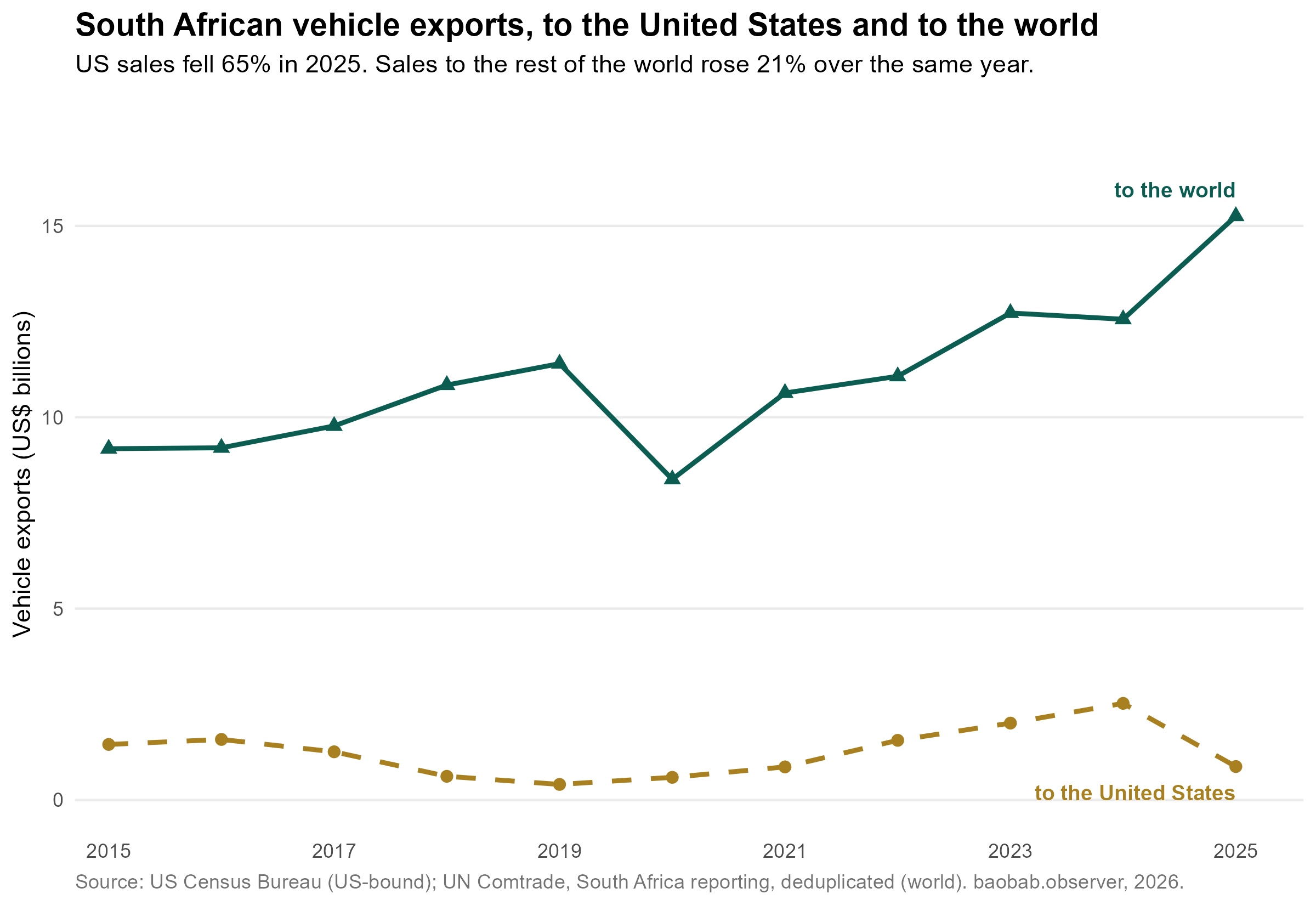
- South Africa lost 65% of its American vehicle sales in one year when the 25% tariff landed, and its vehicle exports to the world still rose 21%. Lesotho has lost close to a third of its garment jobs since 2018, before the tariffs materialised.
- The difference was a rule, and South Africa had it before AGOA existed. From 1961 to 1995 South Africa required a rising share of every vehicle to be made here. That built the component industry: 81,860 jobs against 33,154 on the assembly lines. In 1995 the new government swapped the rule for a reward. For the past decade local content has sat at about 38%.
- Lesotho was handed a different rule. AGOA’s fabric waiver let its factories buy cloth anywhere, so no textile industry ever grew behind them. Twenty-five years on, a shirt sewn in Lesotho for America comes out of a Taiwanese- or Chinese-owned factory and one sewn for South Africa out of a South African-owned one. Lesotho’s own development corporation is now trying to create its first hundred Basotho industrialists.
- In 2025 the EU, Japan and Korea each negotiated an agreement that took the car tariff down to 15%. South Africa asked for one and got none, and its American sales fell by two thirds.
In 2024 South Africa sold the United States $2.5 billion of motor vehicles and paid almost no duty on any of it. The effective rate, duty actually collected against the value of the shipments, was 0.03%. In 2025 that trade fell to $873 million. A 65% collapse in a single year.
There is no mystery about why. Section 232 tariffs on vehicles arrived at 25% in April 2025, on every origin, and AGOA could do nothing about them. What could was an agreement. By the end of the year the EU, Japan and South Korea had each negotiated their rate down to 15%. South Africa paid in full. American car imports fell 18% that year. Japan’s fell 12%. South Africa’s fell by two thirds, the steepest of the ten largest suppliers.
Read on its own, that number looks like a catastrophe, and for the plants concerned it was a bad year. Over the same period South Africa’s vehicle exports to the world went from $12.6 billion to $15.3 billion. Up 21%.
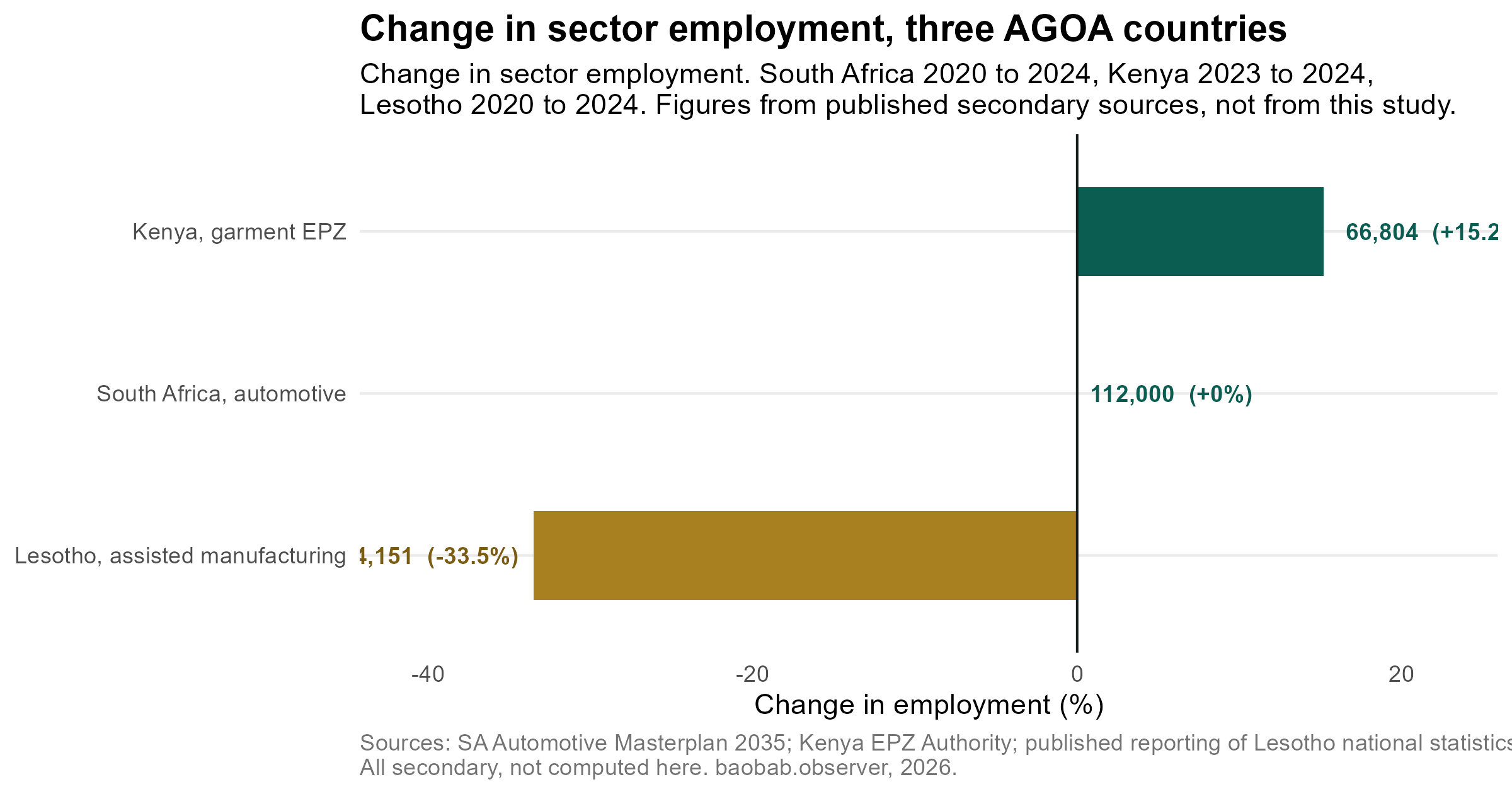
Now a different product, in a different country. In Lesotho, between 2018 and 2024, garment employment in the firms its development corporation assists fell by roughly 16,000, to 34,151. Close to a third of the workforce, gone, and that was before the 2025 tariffs materialised. In all fairness there were a number of events that could have led to this: the pandemic took orders, wages rose, and Asian competition did not pause.
What Lesotho did not have was anywhere else to go. A T-shirt cut and sewn for Walmart under a rule that permits Asian fabric is a T-shirt made for one buyer, and when that buyer changed the price there was nowhere else to send it.
Same programme. Same twenty-five years. Same duty-free access to the same market. One country lost two thirds of its American sales overnight and still grew. The other has been shrinking since 2018.
You could say vehicles are a better business than T-shirts, and some would say you are right. It depends on what better means. A car carries thousands of parts and a supplier tier with many rungs to climb; a T-shirt carries a handful of steps, and the big ones need capital and scale. But a sewing floor takes on people a car plant never will. The more interesting question is why two countries came through the same turn in the market so differently. South Africa brought something to AGOA that Lesotho was never given, and it was not a tariff concession.
What South Africa brought
In September 1995, five years before AGOA existed, South Africa began the Motor Industry Development Programme. It was the high water mark of the Washington Consensus, and a newly democratic government was being advised from every direction to liberalise and get out of the way. It did half of that. It dropped the rule and kept an industrial policy, as much of one as the moment allowed.
Local-content requirements are older than that. Phases one to six ran from 1961 to 1995, and the supplier base the MIDP inherited was built under them, over thirty-four years, by firms and workers inside an apartheid economy that wanted self-sufficiency because it was under sanctions. Nobody should mistake that for a development policy, and nobody should read the result as a credit to the regime. It was a state protecting itself, and the instrument it reached for happened to be the one that builds an industry. What 1995 changed was the direction: a protected industry built for import substitution became one built for export. That is a real achievement, and a democratic government’s. But the factories were largely already there.
The rule ended in 1995. What the MIDP put in its place was a tariff-driven scheme under which import duties could be offset by credits earned from exporting, designed to make it worth a manufacturer’s while to build components here rather than ship them in. Justin Barnes and Anthony Black, in their assessment for Trade and Industrial Policy Strategies, were blunt about the output: the design handed assemblers a disincentive to raise their local content at all, because the credits could be earned in full on the domestic content of an export, raw materials included.
The MIDP went on to 2012 and was replaced by the Automotive Production and Development Programme, which ran to 2020, and that was folded into the South African Automotive Masterplan, running to 2035. Three programmes, thirty years, five presidencies. The APDP kept the shape and changed the sums, and the masterplan inherited it. None of the three is a rule. All three are rewards.
So the masterplan’s target is 60% by 2035, from a baseline of 38.7% in 2015, and the number has not moved. Local content was about 38.1% in the third quarter of 2025. The target is still reachable, but a great deal would have to change first, and the Minister of Trade, Industry and Competition has said what. In June 2026 Parks Tau called the localisation record “negligible and lacklustre” and named the cause: the assemblers and most of their suppliers are foreign-owned, and their decisions on procurement, upgrading and finance are taken at head office abroad. The volumes aren’t there either: 515,850 locally built vehicles were sold at home in 2024 against a plan target of 784,509, and 64% of the vehicles sold here are imports.
Part of that is the shape the 1995 turn to export produced. The Polo is built at Kariega for here and for Europe, and more go out than stay: of the two million built there, 1.4 million were exported and 593,000 sold at home. Each plant is built around export volumes of a few models, and the rest of what South Africans buy comes in. Harsh as the minister’s verdict is, it holds. Government’s answer so far is minimum local-content thresholds in public procurement and a review of the plan, which is under way. Whether there is the appetite to go further, to a binding rule for the whole industry, is the open question.
Take Botswana. Fifty-eight unbroken years of one government, ratings among the best on the continent, diamond revenue, a seat in the customs union with South Africa, and the same American market. Everything a long-tenure story would credit South Africa with, Botswana had more of. Manufacturing was 5.7% of its economy in 2025 against South Africa’s 12.3%. What it sells America is diamonds, 99% of the half a billion dollars it shipped in 2024, and diamonds enter duty-free for everyone, so its entire annual AGOA benefit is about a hundred thousand dollars. If stability alone built industries, Gaborone would have one. To be fair, Botswana is also landlocked, small, and on a hard currency built on mineral rents, so the comparison kills the stability story without proving the policy one.
Long tenure explains none of this.
The industry’s own figures say where to look. In 2024 the component sector employed 81,860 people against 33,154 on the assembly lines. Headcount alone does not show what a rule built; a sewing floor in Maseru employs tens of thousands with no rule at all. What does is the share of each vehicle those firms make, and where that share came from.
Same country, same plants, same firms, two policy regimes one after the other. Under the rule a component industry got built. Under the reward, the share made here has sat at about two fifths of the vehicle for the past decade.
You will object, and you should. Isn’t this simply what maturity looks like? A supplier tier gets built, it reaches whatever share the market will bear, and it stops. Crediting the rule with the rise while blaming the reward for the plateau is having it both ways.
The industry doesn’t describe itself that way. The masterplan treats 38% as a shortfall serious enough to put the plan under review, and an industry at its limit does not lobby for a binding rule to push it further. Renai Moothilal, who runs the association the component manufacturers belong to, wrote in July that 84% of the rebate credits meant to drive localisation are sold on to importers, and that what the sector wants is mandated local content and minimum volumes, on the Thai model. They have an interest in saying so, since a rule guarantees their order book, and it is still not what an industry at its limit asks for. The people who make the parts want the rule back.
So how much of this was AGOA? It arrived in 2000, five years in, and it did something specific and valuable: it made the United States a viable destination for vehicles that South Africa’s own policy had already made it possible to build. In 2024 the United States took 20.1% of South Africa’s vehicle exports, a fifth of the market and not the industry.
I have argued the other way in print. In September 2013 I co-wrote a piece in Engineering News with Tinashe Kapuya headed “AGOA: A boon for South African Vehicle Exports”, which gave the preference the credit for a trade flow. It was right about the flow and wrong about the direction of the causation, and so about which instrument was doing the work. AGOA opened a door. Industrial policy built the thing that could walk through it.
Anyone in the industry will say what this leaves out. The decision to send a South African-built car to Charleston or to Bremerhaven is not taken in Pretoria. It is taken in Wolfsburg, Munich, Stuttgart, Toyota City and Dearborn. Policy here never chose those markets and couldn’t redirect a single container. What it did was make the plants worth having in the first place, and make enough of each vehicle South African that when one route closed, the plant didn’t.
What Lesotho was given instead
Lesotho got the third-country fabric provision.
The provision is usually described as generosity. Ordinarily a preference like this requires the goods to be substantially made in the country claiming it, and for apparel that means the fabric has to come from there or from the region. The third-country fabric derogation waives that. A factory in Maseru may import cloth from anywhere, cut it, sew it, and ship the garment to the United States duty-free.
It is also restricted, and the restriction is the mechanism. Third-country fabric is available only to lesser-developed beneficiary countries, and the one AGOA country with the mills, South Africa, is shut out of it. Its apparel exports to the United States come to $7.55 million while Lesotho’s built an industry. The provision sorted the continent into countries that could have an enclave and countries that could not.
For a country with no textile industry of its own, that is the difference between having a garment sector immediately and having none. Lesotho took it, and in 2018 the sector still employed some fifty thousand people, making jeans and knitwear for Levi Strauss, Wrangler, Gap and Walmart.
Rotunno, Vézina and Wang went back to the boom years and found that a good deal of what looked like African manufacturing was Chinese cloth passing through: in the last years of the Multifibre Arrangement the United States had capped Chinese apparel and left African apparel uncapped, and ethnic-Chinese firms used the continent as the way round their own quota. Their estimate is that direct transhipment was roughly 22% of African apparel exports between 2001 and 2008, in the categories where the preference arrived without rules of origin.
The people who built Lesotho’s industry are Basotho, most of them women, and the factories are not theirs. The ones that sew for America belong to Taiwanese and Chinese groups, the ones that sew for South Africa to South African firms, and Lesotho’s own development corporation has just set itself the target of creating a hundred Basotho industrialists by 2031, which tells you how many there are now. The wages and the conditions matter, and Basotho workers have fought over both and been written about at length. Foreign ownership on its own is not the difference, though. Not one of South Africa’s seven assemblers is South African, and the minister says most of the supplier firms aren’t either. It is the reason a reward fails and a rule is needed, because a reward leaves the choice at head office and a rule does not. The difference between the two is what sits underneath the foreign factory.
In South Africa a rule put a supplier tier there. In Lesotho there is a mill, and it belongs to Nien Hsing: Formosa Textile spins and weaves denim in Maseru to supply the group’s own jeans plants. Upstream and downstream in the same foreign hands, with nothing in between that a Basotho firm can join. What Lesotho has, after twenty-five years of a preference reaching 1.27% of its entire economy, is a location where other people’s capital meets a tariff line.
The instrument that was missing
The rule says: you may have the benefit, and to keep it you must make more of the thing here. South Africa applied it to vehicles for thirty-four years. The origin rules in the Pacific and European trade agreements Vietnam has joined say the same thing about cloth: yarn-forward in the Pacific, so the spinning happens inside the bloc, and fabric-forward in Europe, so the weaving does. The prospect of them is what pulled spinning and weaving investment into Vietnam over the past decade, though most of its fabric is still imported. Different sector, same device. And Vietnam is the proof the device isn’t peculiar to this continent: no American preference, the full tariff paid throughout, and it grew anyway.
A rule also has to be enforced, and Nigeria shows what happens when it isn’t. Nigeria adopted a National Automotive Industry Development Plan in 2013, ambitious in the South African style, and the national automotive council’s estimate, carried by PwC, put the direct jobs it could create at 70,000. In 2023 it imported over 400,000 vehicles and built fewer than 10,000. The assemblers took the incentives for final assembly and were never required to go deeper.
AGOA had that device and then gave it away. Its ordinary apparel rule asks for American or regional yarn and cloth, which is the same instruction in different words. The third-country fabric provision waives it, and it waives it for precisely the countries with no upstream industry. It was written to get factories running quickly, and it did that. It also made sure no upstream industry would grow, because it removed the only commercial reason to build one.
Most of the literature doesn’t line up behind me here. Mattoo, Roy and Subramanian called AGOA’s rules of origin generosity undermined; Brenton and Ikezuki wanted the fabric waiver renewed, which is what happened; Frazer and Van Biesebroeck found the exports real and large. They were right about the thing they measured. The waiver buys exports now and forecloses the industry later, and which you prefer depends on whether a sector that lasts only as long as the preference is worth having. Lawrence Edwards and Robert Lawrence saw the trade in 2013, twelve years in: the waiver steered the poorest beneficiaries into the garments with the most cloth and the least value added in them, and paid firms to use dear imported fabric instead of the cheap kind a poor country could weave. None of the beneficiaries, they found, had an industry that could survive the preference ending. What this essay adds is that it still holds at twenty-five. The waiver produced somebody else’s factory, and for a fifth of it, not a factory at all.
Congress chose that, and chose it again every time the waiver came up for renewal, and the choice was its to make. Manufacturers were what the waiver traded away, and they have stayed traded away.
What this means for the argument about renewal
The debate about AGOA is conducted almost entirely in terms of duration. Two years, five years, to 2041. Underneath sits an assumption nobody states: that the programme works and simply needs longer.
The evidence says the programme delivers what it is: a market. Where one of us brought an industrial policy to meet that market, we got an industry, and the industry proved able to survive the market being taken away. Where one of us brought nothing, we got an enclave, and an enclave is the thing that disappears when the preference does.
The obvious way to test that is across countries, so I did, and it doesn’t settle anything. Set the eight AGOA beneficiaries that sold America at least a million dollars of clothing in 2018 beside 2024: Ghana grew 181%, Tanzania 89%, Madagascar 79% and Kenya 36%, all with no local-content rule in sight, while Mauritius lost 72%, Rwanda 86% and Lesotho 53%. Income per head explains none of it either. Eight countries were never going to. What survives is the comparison inside one country. South Africa has a motor industry behind the rule and essentially no apparel export industry without it, under one currency, one set of ports and one government. It doesn’t control for everything; South African apparel is also barred from the waiver, so two things differ and not one. I think the rule is doing most of the work, because the country had the cloth to meet the ordinary rule and still doesn’t export. A reader who would rather hang it on the waiver can, and this data cannot stop them.
Lesotho is the case neither account explains. It is poor, it claimed the preference almost perfectly, it had the same rule as Kenya and Madagascar, and it collapsed while they grew. The previous essay turns on it, because it is the largest unexplained thing in this whole study.
The limit on the ask has been found once. Rwanda raised tariffs on second-hand clothing so its own garment makers would have a domestic market to sell into. That is industrial policy of the plainest kind. American exporters of used clothing petitioned, Washington found a barrier to American trade, and Rwanda’s apparel benefits were suspended from 31 July 2018. Kenya, Tanzania and Uganda had adopted the same policy. They withdrew it and kept their benefits. Rwanda held out, and could afford to, because its apparel sales to America came to about $410,000 in 2018. So AGOA has never been tested against the rule. It has been enforced once, against an import barrier, and three of the four countries in its way gave up the policy first. The preference disciplines exactly those of us who have built something on it.
Industrial policy builds economies. Preferences sell what they make, and we know it from South Africa, which has run it both ways.
AGOA was an opportunity. It came with a small margin, it was nearly all claimed, and it can be taken back, because that is what a preference is. What we made of it is ours to answer for: it was offered to our governments, and our governments saw it as a substitute for industrial policy.
Washington wrote a market-access statute and never pretended otherwise. The decision to treat it as a development strategy, and to spend twenty-five years lobbying for its extension without building the thing that would have made it useful, was taken on this continent. I was in some of those rooms.
Which is why the thing worth asking for is an agreement in place of the preference. A preference can’t carry the rule. An agreement can, because rules of origin are the rule in treaty form. We have had ours waived on our behalf. Duration is the ask of someone who thinks the instrument is right and the clock is wrong.
An agreement is the only ask that would make the next twenty-five years different from the last.
The countries that treated AGOA as a market rather than as a strategy are the ones still standing.
Method note
Trade values are United Nations Comtrade, matched to the live United States Harmonized Tariff Schedule at six digits. Duty actually collected is from the United States Census Bureau international trade series and is calculated duty over the value of imports for consumption; the series begins in 2010. South African vehicle exports to the world are Comtrade with South Africa reporting, deduplicated across customs and mode-of-shipment codes, which if summed naively overstate the total roughly fourfold; the 2024 figure of $12.56 billion is consistent with independent industry estimates. The world-export figure is a value in dollars and is not split into price and volume: the 2025 weights are unreliable and are discarded, so whether it is more cars or dearer ones the source cannot say. Reporter-side export data for most other African economies proved unusable on inspection, with several reporting lower total exports than the United States alone records buying from them, and no diversion claim is made here on their behalf.
South African employment figures are primary. They are from naamsa, the Automotive Business Council, Automotive Trade Manual 2025, reporting Automotive Production and Development Programme indicators: average monthly employment by vehicle manufacturers 33,154 in 2024 and component sector employment 81,860, against 33,509 and 82,560 respectively in 2023; total automotive manufacturing employment 115,014, and some 500,000 formal jobs with the retail side included. Local-content figures and the 60% target are from the South African Automotive Masterplan 2035, whose baseline is 38.7% in 2015; the 38.1% for the third quarter of 2025 is naamsa’s industry customs account figure as the minister cited it. The reasons the target is off track are the minister’s own: Parks Tau, reported by Linda Ensor in Business Day on 30 June 2026, called the localisation record “negligible and lacklustre”, attributed it to foreign-owned assemblers and suppliers whose “decision-making regarding procurement, industrial upgrading and finance was centralised in their offshore headquarters”, announced minimum local-content thresholds for public procurement of buses, motor vehicles and yellow equipment under the Public Procurement Act, and confirmed that “the review of the masterplan itself is underway”. The volume and import figures are from his address to the component makers’ show on 13 August 2025, as reported by Freight News the next day: “domestic sales of locally produced vehicles plummeted to 515 850 units in 2024, far below the South African Automotive Masterplan 2035 target of 784 509”, and “64% of vehicles sold here are imports”. Vehicle and component production as a share of manufacturing output is 22.6% for 2024 and 21.9% for 2023, which is the figure naamsa’s own website still carries. The Polo figures are Volkswagen Group Africa’s own, from its newsroom of 19 November 2025: two million Polos built at Plant Kariega, “592 840 were made for the local market, while 1 407 160 were produced for export”, and “since July 2024, plant Kariega has been the only Volkswagen plant exporting the Polo to Europe and the Asia-Pacific regions”. That each plant is built around export volumes of a few models is the industry’s structure as the five headquarters below describe it, and is stated as description rather than as a count. That the MIDP abolished local-content requirements rather than continuing them is from Justin Barnes and Anthony Black, The Motor Industry Development Programme 1995-2012: What have we learned?, a paper for the International Conference on Manufacturing-led Growth for Employment and Equality, Johannesburg, May 2013, published by Trade and Industrial Policy Strategies with the file dated 15 April 2014, read directly on 16 September 2026. In its own words: “the excise duty based local content system was dropped and replaced by a tariff driven programme”; “import credits could be earned on the full domestic content value of exports, including raw material content”; and the result was “a disincentive on the part of vehicle assemblers to increase their local content levels”. An earlier draft of this essay described the three programmes as one continuous requirement. That was wrong, and it was the load-bearing sentence. The current position is Renai Moothilal of the National Association of Automotive Component and Allied Manufacturers, writing in Business Day on 6 July 2026.
Lesotho and Nigerian employment figures remain secondary and should be treated as indicative. The Lesotho figures are the Lesotho National Development Corporation’s, which counts jobs in the firms it assists rather than across the whole sector; the decline of roughly 16,000 between March 2018 and March 2024 is as reported by GroundUp and Bird Story Agency rather than computed here, so the 2018 base is approximate and the chart says so. The figure sometimes quoted for the sector before AGOA, around seventeen thousand, could not be sourced and is not used. The employment chart also carries Kenya: garment employment in its export processing zones was 66,804 in 2024, up 15.2% on 2023, from the Kenya National Bureau of Statistics Economic Survey 2025 (C-190). It is there because Kenya holds the same waiver as Lesotho and grew, and its window is one year against Lesotho’s six, as the chart says. Ownership. That Lesotho’s export industry is made up of two kinds of foreign firm, affiliates of largely Taiwanese transnational producers supplying the United States under AGOA and South African manufacturers supplying South Africa, is Mike Morris and Cornelia Staritz, Industrial upgrading and development in Lesotho’s apparel industry: global value chains, foreign direct investment, and market diversification, Oxford Development Studies 45(3), 2017, read in its working paper version of 2013. That no Basotho-owned factory has been found among the exporters is the concordant statement of the reporting that has looked (Mail and Guardian, 3 October 2016; Equal Times, 25 February 2015; Bird Story Agency, 23 July 2026), and is stated here as what the record shows rather than as a count. The Lesotho National Development Corporation’s Letsema Strategy 2026 to 2031, with its targets of 50,000 new jobs and 100 Basotho industrialists, is as reported by Newsday (Lesotho), 12 May 2026, and as LNDC announced it on 12 April 2026. An earlier draft said the government offers Basotho-owned firms subsidised factory shells; no source for that could be found, LNDC’s own pages offer factory shells to any manufacturer, and the claim is withdrawn. Nigerian projections and outcomes are from the National Automotive Industry Development Plan and subsequent trade press; the 70,000 direct jobs is the National Automotive Design and Development Council’s estimate of the industry’s potential, as carried in PwC’s report Africa’s Next Automotive Hub, not a target written into the plan itself. Any figure that moves will be corrected here.
The literature on AGOA and rules of origin. Frazer, G. and Van Biesebroeck, J., Trade Growth under the African Growth and Opportunity Act, Review of Economics and Statistics 92(1), 2010, also NBER Working Paper 13222, read in the working paper version. They estimate AGOA’s effect with a triple difference-in-differences across countries and products and find a large and robust impact on American apparel imports, growing over time, largest where the tariff removed was largest, with no offsetting fall in exports to Europe. They also record that as of 2 January 2007 South Africa was the only one of twenty-seven countries eligible for the apparel provision that did not qualify for the special rule, which corroborates the exception described above from a source outside this study. Rotunno, L., Vézina, P.-L. and Wang, Z., The rise and fall of (Chinese) African apparel exports, Journal of Development Economics 105, 2013, pages 152 to 163, for the transhipment estimate of roughly 22% over 2001 to 2008 and for the finding that it concentrates in categories where the preference came without rules of origin. The counter-position is Mattoo, A., Roy, D. and Subramanian, A., The Africa Growth and Opportunity Act and its Rules of Origin: Generosity Undermined?, World Economy 26(6), 2003 (working paper version), and Brenton and Ikezuki (2004); both are cited here from Frazer and Van Biesebroeck’s account of them rather than read directly, and are named because an essay arguing for rules of origin should say who argues the other way. The argument of the waiver section is not new, and its authors are Edwards, L. and Lawrence, R.Z., AGOA Rules: The Intended and Unintended Consequences of Special Fabric Provisions, Peterson Institute for International Economics Working Paper 13-11, November 2013, and the earlier NBER Working Paper 16623 of December 2010, both read directly on 16 September 2026. In their words: AGOA preferences “caused least developed AGOA recipients to specialize in fabric-intensive products with low value added”; they “discourage backward linkages because they induce exporters to use relatively expensive fabrics rather than the cheaper fabrics that are more likely to be produced in poor countries”; and after twelve years beneficiaries “still do not have viable internationally competitive industries that could survive without the preferences”. This essay’s contribution is that the finding still holds on 2024 data, with the one mill in Maseru in the same foreign hands, and it should be read as replication. The 2010 version also says that “Lesotho and other AGOA countries, even South Africa”, lacked “the domestic textile industry that would allow them to meet the regular clothing rules of origin”; the 2013 version drops the sentence. This essay holds that South Africa had the cloth to meet the ordinary rule: it is the one beneficiary with a spinning and weaving industry of any size, and a beneficiary’s own fabric counts as regional under that rule. That is the author’s judgement, set against the 2010 sentence and stated as such.
Who is barred from third-country fabric. South Africa and Gabon. The rule is restricted to lesser developed beneficiary countries, per capita GNP below $1,500 in 1998, and those two are the only AGOA beneficiaries above that line without a statutory exception. Gabon was reinstated as a beneficiary with effect from 1 January 2026, by proclamation of 19 May 2026, and is not designated a lesser developed country. It ships no apparel, so it changes nothing here. The first essay in this series records the same reinstatement and leaves Gabon outside the study frame for the same reason. Mauritius was also above it and was granted the status by the Miscellaneous Trade and Technical Corrections Act of 2004, signed 3 December 2004, subject to a cap of roughly 27 million square metre equivalents. Mauritius is constrained, not excluded. Botswana and Namibia were above the line too and were granted the status by the AGOA Acceleration Act of July 2004. An earlier draft of this essay said South Africa and Mauritius were both excluded; that is the same error the second essay in this series corrected on 1 September 2026.
The five cities are the five headquarters that matter for South African vehicle exports, checked in September 2026: Volkswagen (Wolfsburg, Kariega plant), BMW (Munich, Rosslyn), Mercedes-Benz (Stuttgart, East London), Toyota (Toyota City, Prospecton) and Ford (Dearborn, Silverton). South Africa has seven vehicle assemblers; the other two are Nissan and Isuzu. Detroit is deliberately not among them. General Motors ceased manufacturing in South Africa in 2017 and sold its Struandale plant to Isuzu, so naming Detroit in an essay about which producers were still standing would have named the one that left.
Vietnam’s tariff position. Vietnam has no preferential access to the United States for apparel. Its effective duty in the Census series, duty collected over the value of shipments, ran between 17.8 and 19.1 per cent in every year from 2010 to 2024. The origin rules it faces are the yarn-forward rule of the Comprehensive and Progressive Agreement for Trans-Pacific Partnership, in force for Vietnam from January 2019, and the fabric-forward rule of the EU-Vietnam agreement, in force from 1 August 2020, which requires the cloth to be woven in Vietnam or the EU but allows the yarn to be imported. The United States is party to neither.
The 2025 tariff year. The Section 232 automobile tariff is Proclamation 10908 of 26 March 2025, 25 per cent from 3 April 2025. The reductions to 15 per cent for the European Union, Japan and South Korea follow the agreements each concluded with the United States in 2025 and the notices implementing them in the Federal Register: for Japan the executive order of 4 September 2025 and the tariff notice of 16 September, for the European Union the notice of 25 September 2025, and for South Korea the notice of 4 December 2025, applying from 1 November. South Africa’s 30 per cent tariff from 7 August 2025, charged separately from the automobile tariff, and the deal sought and not reached, are from the Presidency’s statement of 1 August and note of 4 August 2025. The import changes are United States imports for consumption of motor cars, HS 8703, by origin, 2024 to 2025, from the Census series: all origins down 17.9 per cent, Japan 11.6, South Africa 67.5, from $2,416 million to $786 million. Script 316. The $873 million and 65 per cent in the opening paragraph are this essay’s own vehicle series, matched across Comtrade and the tariff schedule at six digits, which is wider than HS 8703; the two series differ in scope and both put the fall at about two thirds.
The eight-country comparison is every AGOA beneficiary on the 2025 list whose apparel shipments into the United States, HS chapters 61 and 62, imports for consumption, were at least $1 million in 2018: Mauritius, South Africa, Ghana, Kenya, Lesotho, Tanzania, Rwanda and Madagascar. Growth is 2018 to 2024, the window used throughout; income is World Bank GDP per head in 2018. The Spearman rank correlation between the two is minus 0.10 across the eight, minus 0.14 with Lesotho held out, and minus 0.60 with Rwanda also held out, on six countries and not significant. The pattern is sensitive to the endpoint: on windows ending in 2023, the year American apparel imports fell by more than a fifth for every supplier, the correlation turns strongly negative, and it vanishes with the 2024 recovery. That sensitivity is why a cross-section of eight is not asked to carry a general claim here. Script 315.
Eligibility follows the United States Trade Representative’s 2025 list, cross-checked against Congressional Research Service IF10149 of 17 February 2026. Rwanda’s suspension, and the withdrawal of the same used-clothing policy by Kenya, Tanzania and Uganda, are as stated in the Trade Representative’s July 2018 announcement; the petition that opened that review, from the Secondary Materials and Recycled Textiles Association, is the first filing in docket USTR-2017-0008. Rwanda’s 2018 apparel shipments to the United States, $410,268, are from the same series as the South African figure above.
Botswana’s comparison figures are from this study: US imports and duty saved from the tariff and trade pipeline, manufacturing value added as a share of GDP from the World Bank. Its export mix is from the Census series used throughout: imports for consumption from Botswana in 2024 were $497 million, of which $494 million, 99.4%, fell in chapter 71, precious stones and metals, which for Botswana is diamonds; duty collected on the whole was $11,569. Unworked and polished diamonds enter under heading 7102 at a general rate of free. Botswana’s ruling party governed from independence in 1966 until its defeat in the election of 30 October 2024, conceded by President Masisi the next day, as reported by France 24 and Al Jazeera on 1 November 2024. Botswana left the rand in 1976 to issue its own currency and sits outside the Common Monetary Area, and the pula has been the stronger currency since. Manufacturing value added as a share of GDP is used here only to compare two economies of broadly similar structure, and it should not be read as a general measure of industrial capability: the ratio rises when other sectors shrink, which is why Zimbabwe posts a higher share than South Africa while having deindustrialised.
The Motor Industry Development Programme began in 1995 and AGOA in 2000. AGOA did not create South Africa’s motor industry and this essay does not claim it did. The claim is narrower and, I think, more useful: the industry existed because of domestic policy, AGOA supplied one market among several, and when that market closed the industry was able to do without it.