Trade & Markets
The Preference That Was Already There
On nine tenths of its tariff lines, AGOA was delivering something a different American programme was delivering too. Then that programme lapsed, and AGOA's reach grew fourfold without a word of it changing.

- Of the 9,670 tariff lines that carry AGOA’s symbol, 8,978 also carry the GSP symbol. Ninety-three per cent. Only 692 lines are AGOA’s alone, plus 2,456 apparel lines.
- So for two decades, outside apparel, AGOA was adding security to access we already had under a different statute. It exempted us from GSP’s competitive need limits, the ceiling that graduated anyone who used the preference well.
- Then GSP expired on 31 December 2020 and has stayed expired. AGOA’s legal reach grew close to fourfold overnight, from about 3,100 operative lines to about 12,100, and no trade strategy anywhere was revised, including ours.
- GSP covered fifteen of the 2,456 apparel lines. Textiles were written out of it at the start as import-sensitive, which is why apparel is the one sector where AGOA stood alone, and the one sector where it demonstrably moved production.
Nine minutes if you read the whole thing. The workings, including the claim I got wrong first, are below.
Of the 9,670 lines in the United States tariff schedule that carry AGOA’s eligibility symbol, 8,978 also carry the symbol for the Generalized System of Preferences. Ninety-three per cent. Only 692 lines are AGOA’s alone.
The Generalized System of Preferences is the older and larger of the two. It dates to the Trade Act of 1974. At the point it expired it covered 119 developing countries and territories, not thirty-two African ones. Every AGOA beneficiary is also a GSP beneficiary, and not by coincidence: GSP eligibility is a precondition of AGOA eligibility. Equatorial Guinea and Seychelles are ineligible for AGOA today for exactly that reason, having graduated out of GSP on income. So on the overwhelming majority of products where AGOA offers a country duty-free entry, that country already had it. Under a different statute.
There is one enormous exception, and by now it will not surprise you. Apparel.
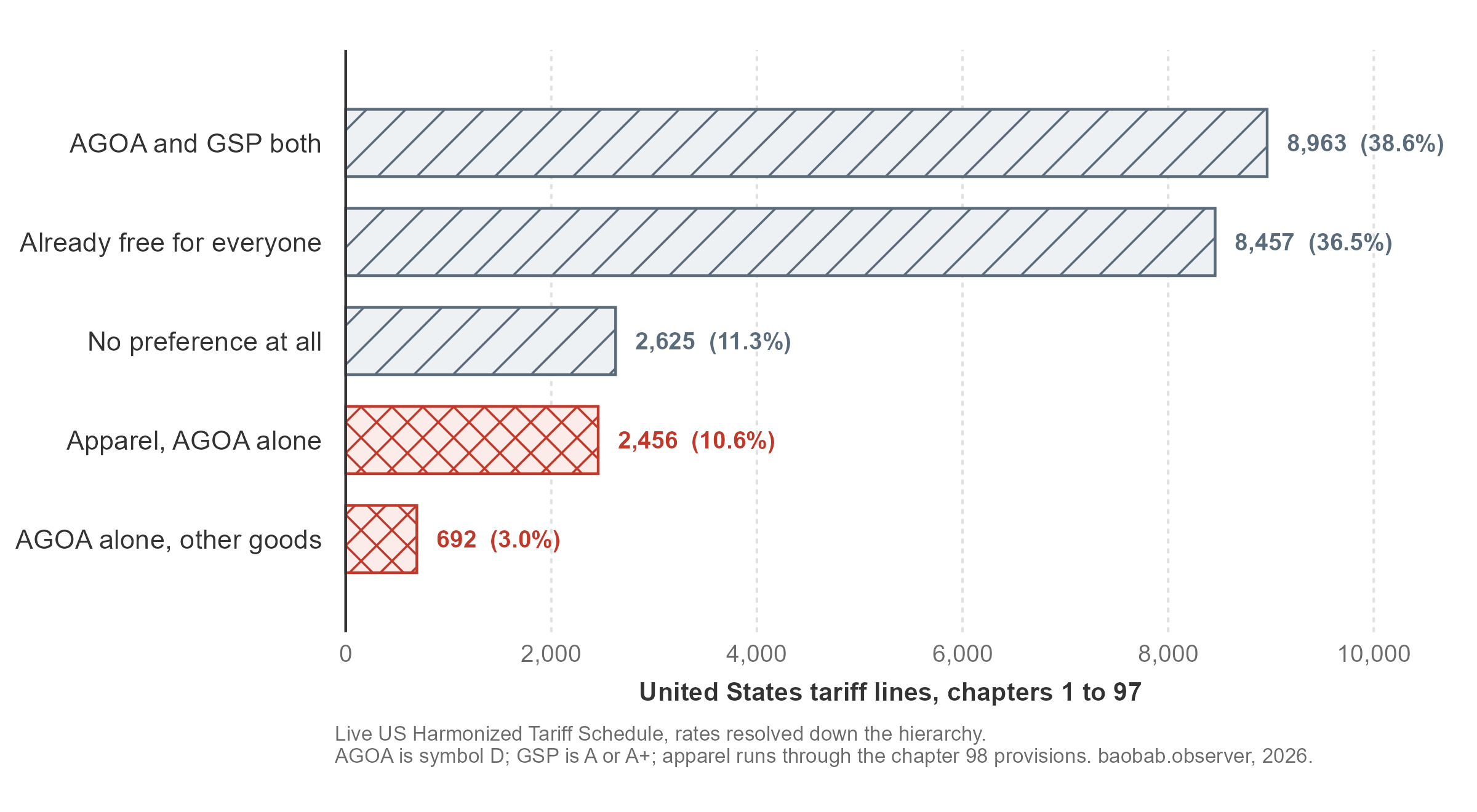
Of 2,456 apparel lines, fifteen carry GSP. Textiles and clothing were written out of the Generalized System of Preferences at its inception as import-sensitive, along with watches and some categories of steel, glass and electronics. Those exclusions were the price of getting the programme through Congress in the first place, and they carved out precisely the sectors a developing country might realistically manufacture.
So the maths of what AGOA exclusively provides comes to this. Of 23,193 product lines in the schedule, 8,963 non-apparel lines are covered by GSP as well, which is the 8,978 above less the fifteen apparel lines that carry it, 8,457 are already duty-free for anyone trading normally with the United States, and 2,625 carry no preference at all. What is left, what AGOA and only AGOA delivers, is 692 ordinary lines and 2,456 apparel lines. Thirteen and a half per cent of the schedule, four fifths of it garments.
Where the obvious conclusion goes wrong
The obvious conclusion is that AGOA was largely redundant outside apparel. If a country would have received duty-free entry under GSP anyway, AGOA’s marginal contribution on that line looks like nothing. But GSP is not a clean fallback, and the two reasons pull in opposite directions.
The first cuts against AGOA. GSP carries competitive need limitations. A beneficiary whose exports of a product exceed half of all American imports of it, or a dollar threshold, loses GSP for that product. The programme is built to graduate anyone who uses it well. So GSP on paper was never GSP in practice for a successful exporter.
But AGOA beneficiaries were exempted from those limitations, and the exemption came from AGOA itself. The Act did not simply add 1,800 products of its own. It reached into the older programme and removed the ceiling for African countries. A Kenyan exporter who came to dominate a product line kept the benefit that a Thai or Brazilian exporter would have lost.
Which means AGOA’s contribution on the shared lines was real, and it was not the tariff break. It was the security of the tariff break.
I wrote that argument myself in 2015, in the master’s thesis I have already been rude about in this series, and then did nothing with it. AGOA, it says there, removes the administrative burden of GSP’s much shorter renewal cycle, so that beneficiaries “maintain benefits for longer time frames providing certainty for investors and traders, as opposed to countries that export under GSP alone”. And: “AGOA removes the Competitive Need Limitation (CNL) applicable to products that enter the United States under GSP.” What I hadn’t done was count the lines it applies to or ask what happens when the older statute lapses.
And then it expired
The date was 31 December 2020.
It hasn’t been renewed. Not for a year, not for two, not for five. Bills have been introduced. Committees have held hearings. There is bipartisan support for renewal in the abstract, but no legislative vehicle for it in practice. American importers have paid billions in tariffs they wouldn’t have paid had the programme been in force. That has produced a lobby: the Coalition for GSP has run a renewal campaign throughout, put more than three hundred American companies and associations behind a single letter, and had a reform and reauthorisation bill introduced in the House in April 2024. None of it has produced a law. The interested party here is American, organised and well funded, and it has very little tangible traction.
GSP had lapsed before and been restored retroactively more than once, so for a while the reasonable assumption was that this lapse would end the same way. Counting this one, it has lapsed eleven times since 1974, and every earlier lapse was closed. The two longest ran fourteen months from August 1995 and twenty-four months from July 2013, and both were closed retroactively. This one has run more than five years, and there’s no sign of it closing.
That did something to AGOA without amending AGOA. On 31 December 2020, one of our exporters shipping a non-apparel good to the United States had duty-free entry from two directions. On 1 January 2021, one of them was gone. On those 8,978 shared lines AGOA had been adding security rather than access. Overnight it became the only thing standing between our exporters and the ordinary tariff.
Count it in lines. Before the lapse, AGOA was the operative preference on about 3,100 lines, being the 692 it alone covered plus the apparel. After it, AGOA was the operative preference on about 12,100.
That is a count of tariff lines, and a tariff line is a legal object rather than an economic one. I assumed the version weighted by trade would be smaller, on the reasoning that the shared lines carry a lower median margin. Margin is not value, and it is larger.
Weight the same classification by what the thirty-two eligible economies actually shipped in 2025. Of $31.4 billion, 58.2% moved on lines already duty-free for everyone, two thirds of that block being precious stones and metals and another tenth cocoa. 36.6% moved on the lines shared with GSP. What moved on lines where AGOA was the only preference available comes to 4.9%, four fifths of it apparel. So before the lapse, the thing this dispensation uniquely provided carried about one dollar in twenty of what we sold the Americans.
Then the shared lines became AGOA’s alone, and that one dollar in twenty became two in five. By lines the reach grew about fourfold. By trade it grew about eightfold, because the lines AGOA was duplicating on were the ones carrying the goods.
What the change did to the duty actually paid is a different question, and I could not answer it. I tried, using twelve economies that had GSP and never had AGOA, and the test couldn’t resolve it. The comparison group was AGOA countries that kept their preference and had nothing happen to them in 2021. They moved that year with a standard deviation of 1.4 percentage points, which is larger than the effect I was looking for. The 2021 recovery drowns everything at this level of aggregation.
So: the change in AGOA’s legal reach is a matter of counting and it holds. Whether it produced a proportionate change in what exporters actually paid is untested, and settling it needs entry-level data by preference regime, which I have not been able to obtain.
What that means for the two decades before
It changes what we can say about the period everyone argues over. Supporters and critics alike judge AGOA on whether it built industry in Africa between 2000 and 2020. That’s the right question. But for those two decades, outside apparel, AGOA’s incremental contribution over the fallback was close to nothing. A country that had never heard of AGOA and relied on GSP alone would have shipped most of the same goods at most of the same duty.
So the sentence “AGOA failed to industrialise Africa” is, for nine tenths of the tariff schedule, a claim about a dispensation that wasn’t doing much more than GSP.
And where AGOA did something distinctive, it did it rather well. Apparel is the sector GSP excluded, the sector AGOA covered, and the only sector where the preference demonstrably moved production. Lesotho, Kenya and Madagascar built garment industries on lines with no alternative preference behind them. That is the finding: the preference worked where it was the only thing on offer, and did little where it duplicated something else.

Which leaves the harder point. If AGOA’s distinctive contribution was security of access rather than access, and that security was worth no more than the underlying statute’s own renewal prospects, then twenty-five years of advocacy for extension was defending something thinner than it looked.
The uncomfortable symmetry
None of this is an attack on AGOA. The dispensation did a specific thing, in a specific sector, and did it well enough that tens of thousands of people in Maseru and Antananarivo have worked because of it.
The uncomfortable part is elsewhere, and it is about how these arrangements are constructed.
Two American statutes, passed decades apart for different reasons, interact. Between them, they decide what a Zambian copper processor or a Ghanaian cocoa exporter pays at an American port. Neither statute was designed with reference to the other. The interaction has never been the subject of an African negotiating position, as far as I can tell, because it isn’t visible unless you go to the tariff line and compare the symbols.
And when one of the two lapsed, the other’s reach multiplied overnight, and nothing marked it. No summit, no communiqué, no revision of anybody’s trade strategy, ours included. A dispensation that thirty-two governments spend real diplomatic capital defending became far more valuable to them by operation of a gap in someone else’s legislative calendar.
That is what it means to be the subject matter of a statute rather than a party to it. You don’t get told when your position improves, because nobody was thinking about your position when it happened. A party to an agreement is in the room when its terms change, because they cannot change without them. That is the whole difference between what we hold and what we should be asking for.
Method note
Preference coverage is read from the live United States Harmonized Tariff Schedule. A line is treated as AGOA-covered if it carries special-programme symbol D, and as GSP-covered if it carries A or A+. Chapters 61 and 62 are treated as AGOA-eligible despite carrying no symbol D, because apparel access runs through subheading 9819.11 and the chapter 98 special provisions rather than through the ordinary lines; the fifteen apparel lines reported as GSP-eligible are the ordinary-line exceptions.
Counts are of eight and ten digit lines in chapters 1 to 97, with rates inherited down the hierarchy since ten-digit statistical suffixes generally do not restate the parent rate. The figure of 1,800 products commonly cited as AGOA’s addition to GSP is a count of subheadings rather than of lines, and is consistent with the line counts here once the two levels are reconciled.
Everything asserted here about GSP is read from two documents. The United States Trade Representative’s GSP guidebook of November 2020 gives the competitive need limitations (imports of a product from one beneficiary reaching 50 per cent of all American imports of it in a calendar year, or a dollar value raised by $5 million a year) and the statutory exclusions, which are “most textiles and apparel articles, watches, footwear, work gloves, and leather apparel” plus import-sensitive steel, glass and electronic articles, under 19 U.S.C. 2463. The Congressional Research Service’s Generalized System of Preferences: Overview and Issues for Congress, report RL33663, updated 22 November 2023, gives the expiry of 31 December 2020, the 119 eligible countries and territories, the forty-four least-developed beneficiaries, and the renewal table in its Appendix A from which the lapse lengths above are computed. That AGOA beneficiaries are exempt from the competitive need limitations, which is the provision this essay turns on, is 19 U.S.C. 2463(c)(2)(A), cited at note 80 of that report and at page 11 of the guidebook.
Two limitations. First, line-level coverage is not the same as country-product benefit: whether a particular country actually received GSP treatment on a particular line in a particular year depended on its own designation and on the limitations described above, and this study measures the schedule rather than the entries. Second, the counterfactual reasoning here assumes an exporter would have used GSP had AGOA not existed, which is a reasonable assumption on a duty-free line and not a demonstrated one.
The trade-weighted split is script 321, run 23 September 2026 on the same regime classification, with each six-digit heading taking the regime most of its lines carry and the universe being the thirty-two economies this study’s own country reference marks eligible for 2025. It is not the trade file’s own eligibility flag, which is empty for South Africa and would have dropped the largest exporter in the set; that mistake was made and caught the same morning. Every heading in the trade data matched a classified heading, so nothing is dropped at the join. The figures say which regime a line sits in, not which preference an exporter claimed on it.
That GSP eligibility is a precondition of AGOA eligibility is visible in the eligibility list itself: Equatorial Guinea and Seychelles are recorded as ineligible for AGOA on the ground that they graduated from GSP. The count of 119 GSP beneficiaries is as at the December 2020 expiry and includes forty-four least-developed beneficiaries and seventeen non-independent countries and territories, which Appendix B of the same report lists individually from the 2020 tariff schedule.
The strongest objection to the argument above, and I cannot close it here. If no African exporter ever approached a competitive need threshold on a shared line, then the exemption AGOA bought was theoretical and the security it conferred was worth nothing in practice. Settling that needs the record of which beneficiaries triggered or were waived from the limitations, year by year and product by product, which this study does not hold. Until it is settled, the claim that AGOA’s contribution on the shared lines was security should be read as what the statute provided rather than as what exporters realised. Two further things the schedule cannot see: which preference an importer actually claimed at entry, and whether the two schemes were equally easy to claim, since each carries its own rules of origin and the cost of proving them is not in the tariff rate.
Prior art, which I checked late. The overlap is not a new observation. agoa.info’s own Guide to GSP and AGOA states it at the level of subheadings: around 5,100 overlapping, roughly 270 general goods under AGOA and not GSP, over 1,700 textile and clothing lines against about a dozen that are GSP-eligible. Those figures are a different count of a different object, and this essay’s line-level figures do not contradict them. And the security argument is in my own 2015 thesis, quoted above, which cites the United States Trade Representative for it. What I can claim is narrower than the argument: the count at line level, the same classification weighted by trade, and the question of what the 2020 lapse did to it.
The first essay in this series reports a median preference margin of 4.4%, measured against the ordinary tariff. On the shared lines that is the right measure of the duty avoided and the wrong measure of what AGOA contributed, which is the distinction drawn here; essay 01 now carries the qualification and points forward to this one. I set out the redundancy claim in a stronger form before checking the competitive need provisions, and corrected it. I also first described the 2021 change as a tripling, which is a count of lines loosely stated; it is closer to fourfold on lines and smaller on trade value. The version above is what survives.